
Swing trading stocks is an active approach that aims to capture intermediate price moves over a period of days to a few weeks. It sits between buy and hold investing and frenetic intraday trading. For a disciplined trader it offers a balance: less screen time than day trading, faster feedback than long term investing, and the potential to compound gains more quickly than passive strategies if costs and risk are properly managed. It also exposes you to specific operational frictions that many newcomers underestimate: overnight financing on margin accounts, dividend and corporate action effects, weekend gaps, and the behavioural tendency to micromanage positions. This article explains what swing trading stocks requires in practical terms, how to build a repeatable process, how to choose stocks and entries, how to manage risk and position sizing, and how to test and scale a real world program.
This guide will focus on swing trading on the stock market. If you want to learn more about swing trading in general then I recommend that you visit the website Swing Trading. Swingtrading.com features hundreds of expert articles about swing trading.
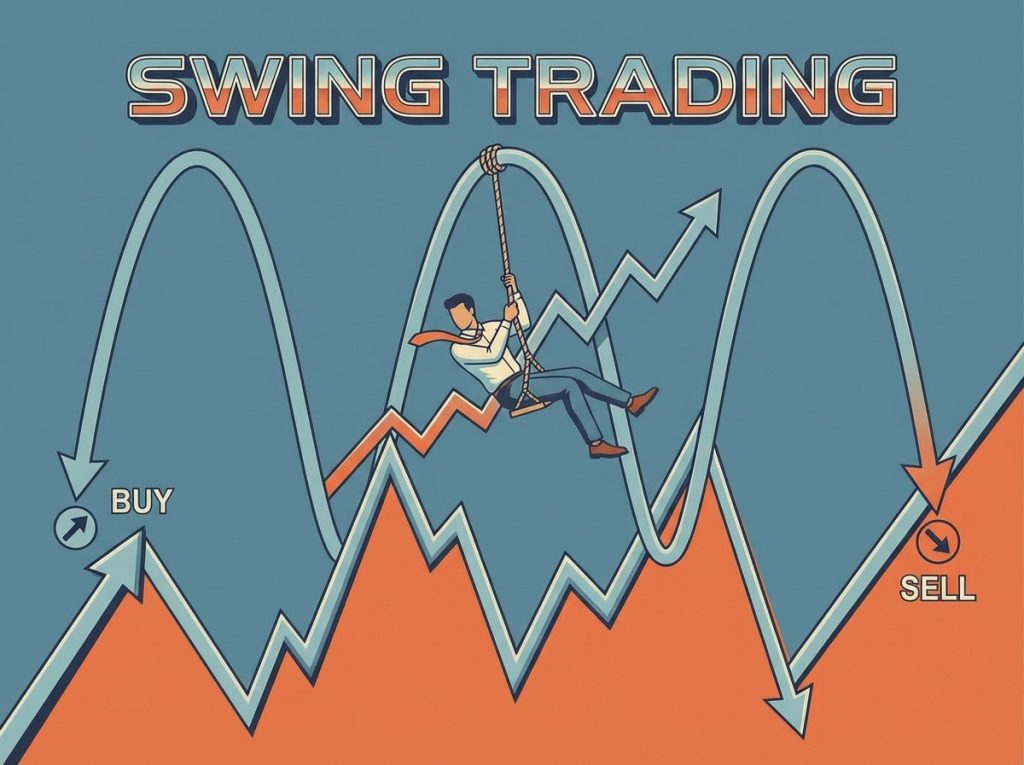
What swing trading stocks means in practice
Swing trading is about exploiting price moves that last longer than a single session but shorter than multi year trends. You identify setups where the odds favour a multi day or multi week move in your favour. The instruments are individual equities and often their ETFs for sector exposure. Trades are sized to reflect both stop distance and the dollar risk you are willing to take, not to fit arbitrary percent rules. Execution does not demand ultra low latency, but it does demand reliable fills and consistent behaviour from your broker. The typical swing trader looks for momentum that can be held through a few candles, or for mean reversion into a structural support with an anticipated bounce. Either way you must accept that some trades will be stopped out quickly and that a few winners will carry the return profile.
Choosing stocks for a swing program
Stock selection is the baseline decision that determines your operational workload and your cost profile. Trade liquid names where possible. Liquidity reduces slippage at entry and exit and makes it feasible to scale size over time. Liquid large caps and mid caps are common choices because they show predictable spread behaviour and handle earnings related volatility in a way you can plan for. Smaller caps can produce larger moves but they also produce larger overnight gaps and erratic fills. Beyond liquidity, prefer stocks with clear volatility characteristics you can model. Stocks with predictable news cycles or with steady trend behaviour fit swing rules. Stocks that live in a perpetual state of headline chaos are poor candidates unless your system explicitly targets event volatility with bespoke sizing rules.
Fundamentals still matter. Swing trading is not pure charting. Knowledge of earnings dates, dividend schedules, corporate actions and sector thrust shapes trade decisions. An otherwise valid technical breakout that occurs a day before an earnings release is a very different proposition from the same breakout in quiet week. If you trade ETFs for sector exposure you avoid single company event risk but you also accept smaller percentage moves. Good stock selection combines liquidity, predictable volatility and an informational advantage: you either know where the event risk is or you intentionally avoid it.
Entry and signal design
A repeatable entry rule is the heart of any swing plan. Use time frames consistent with the intended hold period: daily charts and four hour charts are common because they smooth intraday noise while remaining sensitive to emerging momentum. Signals can be momentum based — a breakout above a consolidation with volume confirmation — or mean reversion based — a bounce off a well defined support coupled with divergence on momentum indicators. Whatever your signal, define it precisely and quantify it. What does “breakout” mean numerically, at what candle close, how much volume confirmation, and what price range invalidates the setup. Vagueness is the enemy of repeatability. Many good swing strategies are simple rules executed consistently rather than complicated heuristics applied ad hoc.
Stop placement and trade sizing
The two most important decisions you make for any swing trade are where to place the stop and how large the position will be at that stop. Start by converting stop distance into dollar risk and set your position size so that this dollar risk fits your risk budget. Express risk in fixed currency units or in a volatility adjusted dollar figure rather than as a percent of a tiny account, because percent metrics encourage oversized positions on small accounts. Use market structure to place stops: swing lows and highs, volatility bands such as ATR multiples, and gap support levels are defensible places for a stop. Avoid arbitrary percent stops that ignore the asset’s noise. A stop that is too tight will produce a high turnover of losing trades and eat edge via costs. A stop that is too loose will create ruin risk. Balance is the objective.
Managing winners and losers
An important part of being a successful swing trader is to have an exit plan already devised when you enter a trade. Two common exit plans are to exit the position when it reaches a certain profit level or to use a moving stop loss, to automatically close the position when the trend breaks. Personally I prefer the second method. It requires more work but allows you to maximize your profit on each strand. Provided that you’re trading a liquid asset,
A hybrid approach can work: scale out a portion at a nearby target and trail the remainder. The psychological advantage of taking partial profits is real — it reduces the temptation to alter stops after the fact. For losers, accept the pre defined stop. Changing the stop to “give it room” after a loss is a common killer. If you find yourself routinely moving stops wider, that is a behavioural error you must fix through rules or automation.
Time management also matters. Define a maximum holding period consistent with your signal. If the trade has not delivered within that window reassess objectively. Some trades need extra time because the thesis depends on longer term developments, but many marginal trades degrade into noise. A time stop protects capital tied up in non performing positions and preserves optionality for new, higher probability setups.
Earnings and event risk
Earnings season demands explicit rules. Many swing traders avoid holding single stock positions through earnings unless they are paid or otherwise set up to benefit from the event. The reason is simple. Earnings are discrete, often unpredictable jumps that can blow through stops or create large slippage. If your edge does not specifically target earnings volatility and include expected move pricing and optional hedges, the prudent path is to close or reduce size ahead of the report. For event oriented swing strategies size down and use strict stop rules. For trades that intentionally aim to capture earnings driven moves, use option based hedges or accept the larger implied volatility cost as part of the plan.
Execution, fills and broker selection
Execution quality is a practical variable you can measure. Demo accounts hide queueing effects, and platform behaviour under real load can differ from simulated environments. Test fills at the size you intend to run across different sessions. Check how the broker treats stop orders during volatility, whether guaranteed stops are available and at what fee, and whether corporate action handling for dividends and splits is accurate. For swing trading you do not need co located servers, but you do need a broker that behaves consistently on the days you hold positions. Also verify withdrawal mechanics early. The disappointment of locked funds or slow withdrawals typically appears only after profits accumulate.
Costs and the math of viability
Swing trading has recurring costs that must be modelled explicitly. Commissions and spread matter at entry and exit. If you use margin to lever positions, overnight financing or swap costs accrue and must be included in expected return calculations. Taxes and stamp duties depending on jurisdiction also affect net profit. The practical rule: model expected total cost per trade in account currency and ensure your expected edge exceeds that cost with a margin for error. Many otherwise promising strategies vanish once financing and realistic slippage are included. Do not skimp on this accounting.
Portfolio construction and correlation
A swing trader should treat the active book as a portfolio not a set of isolated bets. Correlation between positions can create simultaneous drawdowns that violate your risk budget. Avoid hidden concentration by monitoring sector and factor exposure. Use risk budgets per trade and an aggregate exposure limit. Maintain a cash reserve or margin buffer for margin calls and for opportunistic deployment when the market offers particularly high probability setups. Diversify across non correlated ideas rather than adding similar bets that only look like diversification on superficial inspection.
Record keeping and review
A trading journal is not optional. Record entries, exits, stop placement, the quote at entry, the fill price, and the rationale. Include notes on deviations from the plan and on execution anomalies. Periodic review reveals structural leaks in your approach, such as consistent slippage, a tendency to tighten stops after wins, or an unprofitable subset of setups. Adjust only after sufficient sample size and not because of a few outlier trades.
Testing and scaling
Start small. Backtests illuminate plausibility but forward live testing with real money is the true arbiter. Run a micro account test for a meaningful sample size across different market conditions and reconcile reported fills against quoted spreads. Once the live edge after costs is verified, scale incrementally. Liquidity and execution change with size. A trade that fills fine at a small lot may suffer adverse slippage at larger sizes or trigger different routing by your broker. Incremental scaling allows you to renegotiate fees or move to a higher tier account if justified by volume.
Psychology
Swing trading requires a calm and principled mind. It is important that you do not overreact to downturns in the market and that you do not make impulsive decisions. The key to success as a swing trader is to be consistent with your strategies and your decisions.
A swing trader needs to be able to resist making emotional trades due to previous losses.
Build mechanical rules to limit these behaviours: daily loss limits, maximum trade counts, and forced cooling off periods after rapid losses. Use automation for stop enforcement if your discipline is weak. The best traders design a system that reduces the need for emotionally charged decisions.
Legal and tax considerations
Understand how your jurisdiction treats trading income. Record keeping simplifies tax filing and protects you if audited. If you use margin or derivatives consider the regulatory differences that affect reporting and investor protections. If you trade through multiple brokers for execution reasons keep the record consolidated to present a clear P&L history for tax and for personal performance analysis.
Common mistakes and how to avoid them
The list of errors is familiar because they repeat: overleveraging, ignoring cost, trading illiquid names, poor stop discipline, failing to test live, and insufficient record keeping. Each error has a pragmatic fix: reduce leverage until you can survive typical drawdowns, include all costs in your simulations, restrict your universe to liquid names you can exit quickly, adopt fixed stop rules and enforce them, forward test live, and keep a journal. The fixes are simple. The hard part is doing them consistently.